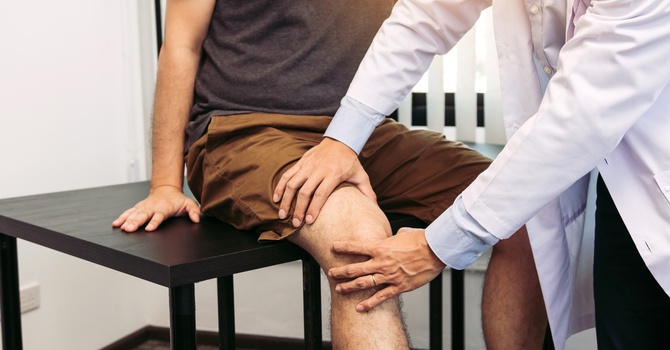
You’ve had the surgery. You’ve logged the hours with the PT and PTA in the initial post-op phase, and you’ve reached that crucial "functional" baseline. For many, this is where the traditional healthcare journey ends. Your surgeon is happy, your insurance company is satisfied, and you’ve been cleared because you can walk without a limp and navigate a flight of stairs.
But for most of our patients at OSO Physical Therapy, "functional" isn’t the goal. It’s the beginning.
As an OCS (Board-Certified Orthopedic Specialist), I see a recurring gap in the standard of care for joint replacements. There is a massive, often ignored space between medically necessary recovery and everything you are actually capable of doing.
The "Medically Necessary" Ceiling
In the current insurance-driven model, physical therapy is often defined by "medical necessity." This means the goal is to get you back to basic activities of daily living (ADLs). Once you can get in and out of a car and walk a block, you are often discharged.
The problem? Life—and especially the life of an active Californian—is not an ADL.
-
Medical necessity doesn't care if you can hike the Redwood trails.
-
Medical necessity doesn't care if you can get back under a barbell for a heavy squat.
-
Medical necessity doesn't care about your tennis serve or your ability to keep up with your grandkids on the beach.
If you stop training the moment you meet the "medical" criteria, you are leaving a significant amount of joint longevity and physical potential on the table.
The OSO Philosophy: Training for Capacity
At OSO, we don’t look at your knee or hip replacement as a finished project just because the incision is healed. We view it as a hardware upgrade that requires a software update—specifically, a robust nervous system and high-level muscular strength to support that new joint.
Strength training after a replacement isn't just about "doing your exercises." It’s about progressive overload. To truly protect your investment (the new joint), we have to build a "buffer" of strength around it. This involves:
-
Hypertrophy and Power: We don't just want the muscle to work; we want it to be resilient. We train to regain the muscle mass often lost during years of pre-op arthritis.
-
Dynamic Stability: Walking on a flat clinic floor is easy. Navigating uneven terrain or reacting to a stumble requires high-level neuromuscular control.
-
Confidence: The biggest barrier after a joint replacement is often the "fear of breaking it." We bridge that gap by gradually exposing you to the movements you’re afraid of, in a controlled, clinical environment.
Bridging the Gap in Alameda
We founded OSO Physical Therapy to be the bridge. We are DPTs who understand the surgical precautions and the biomechanics of your prosthesis, but we are also strength coaches who know that the human body thrives under load.
If you’ve been told you’re "done" with PT but you still don’t feel like yourself, you’re likely stuck in that gap. You’ve achieved what was medically necessary, but you haven't yet achieved what you’re capable of.
Your new joint was designed to move. Let’s make sure the rest of your body is strong enough to let it.
Ben Fedewa
Contact Me